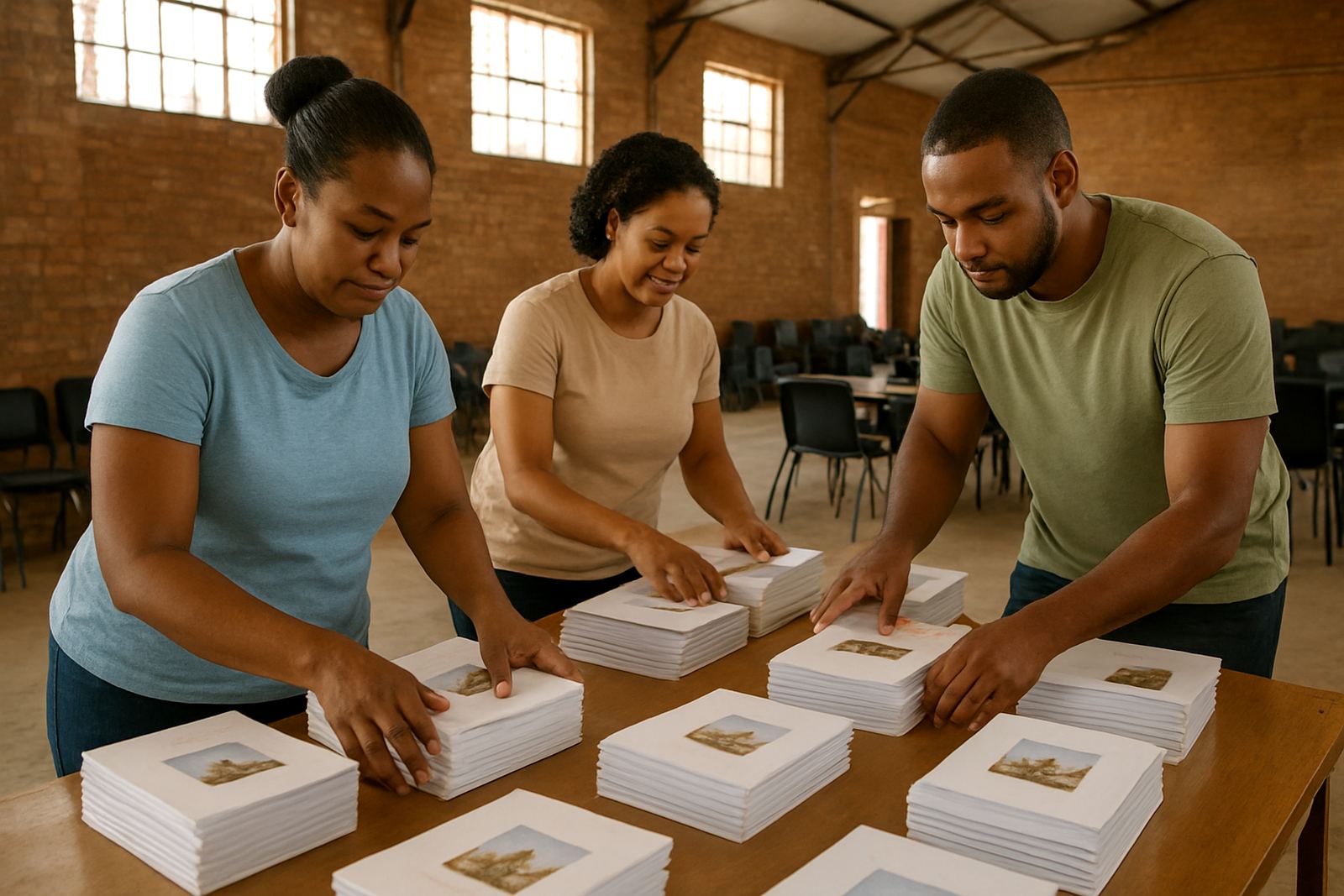


Built for publishers with a rolling schedule
Trade publishing is rarely one title at a time. There are new releases, seasonal reprints, school or corporate supplements, and backlist titles that must be ready when demand rises. Printing House works with publishers who need steady output, accurate colour and clean binding across many SKUs, not just a single one-off job.
Our Industria base is set up for repeat work where page counts, trim sizes and paper stocks may change from issue to issue. That means tighter planning around artwork handover, proof approval, and delivery windows to Johannesburg, Pretoria, the East Rand and nationwide distribution points. For publishers sending books into shops, warehouses or direct mail, timing matters as much as finish quality.
- Short notice reprints for fast-moving titles
- Recurring magazine runs with fixed close-off dates
- Mixed production for hard cover, soft cover and stitched publications
- Delivery planning for publishers across South Africa
Typical production set-up for books and magazines
Most trade publishing jobs move through a fairly standard chain: prepress checks, colour proofing, printing, binding and final dispatch. We handle offset printing for longer runs and flexo printing where the job spec suits that process. The right choice depends on quantity, paper type, image coverage and whether you need stable colour across several printings.
For magazines, saddle stitching is often the quickest option for slimmer titles, while perfect binding works well for thicker books and premium catalogues. Case binding and section sewing are used where durability is important, especially for titles that will be handled often or stored for years. Cover lamination and foil finishing can improve shelf appeal, but only if the artwork and paper choice support it.
- Offset printing for consistent text and image work on longer runs
- Flexo printing for selected publication and packaging requirements
- Saddle stitching for lower page-count magazines
- Perfect binding, case binding and section sewing for book production
- Die cutting, cover lamination and foil finishing for presentation detail
How to plan your layout before press day
Good publication planning starts with the file, not the press. Before production begins, make sure the page count, spine width, bleeds and image resolution are checked properly. Small errors here can affect binding, trim accuracy and final appearance. Johan van der Merwe and the prepress team check artwork early so issues are picked up before paper is cut or plates are made.
It also helps to think about how the book or magazine will be used. A reference title that stays on shelves needs different finishing from a quarterly magazine that is posted out in bulk. The cover stock, lamination choice and binding method should suit handling, storage and transport, especially in Gauteng where dry heat, dust and load-shedding can all affect production planning if files or approvals arrive late.
- Confirm final page count before booking the run
- Allow for spine width changes when the paper stock changes
- Check colour images, margins and barcode placement carefully
- Plan approval time for proofs so there is no last-minute rework
- Match the binding method to the expected handling and shelf life
Common mistakes that slow production
Many publishing delays are avoidable. The most common issue is sending artwork that is not yet print ready, which leads to corrections after the schedule has already been fixed. Another problem is underestimating finishing time. A job may print quickly but still need lamination, folding, sewing, binding and packing before it can leave the floor.
We also see publishers ordering too tightly on quantity. If you only print the exact minimum, a small sales spike or damaged pallet can leave you short. On the other hand, overprinting ties up cash and warehouse space. Siyanda Ramaboa often helps clients balance print quantity against demand so they do not overcommit. Farieda Adams then coordinates bindery output so stitched, glued or cased sections flow through without bottlenecks.
- Sending uncorrected files or late amendments
- Choosing a binding method that does not suit the page count
- Leaving no allowance for proofing and sign-off
- Ignoring pack-out needs for courier or pallet delivery
- Ordering too few copies for a title with repeat demand
Budget ranges for trade print runs
Budget depends on format, page count, quantity, paper and finish. A small magazine or slim soft cover title may sit in the lower thousands, while larger book runs with better paper and finishing will move up quickly. As a guide, publishers should expect smaller production jobs to start around R8 000 to R25 000, mid-size book and magazine runs around R25 000 to R90 000, and larger or more complex runs to move beyond R90 000 depending on binding and finish.
It is better to price with the whole production picture in mind. A low print cost can become expensive if the job needs rework, extra binding time or multiple delivery drops. Oupa Hlungwani oversees production decisions with the team so budgets line up with schedule and quality targets. For nationwide delivery, include pack, palletising and transport in the discussion from the start, not at the end.
Publishers in Sandton, Randburg, Midrand, Roodepoort and Pretoria often work on tight commercial timelines. We are used to that pace. The best savings usually come from cleaner files, stable specifications and repeatable production settings rather than cutting corners on finish.
Binding, packing and delivery that supports release dates
Once the print run is complete, the final steps matter just as much. Section sewing, perfect binding and case binding must be checked for alignment and strength. Covers need to sit square, pages must open cleanly and the finished pack count should match the order. Siphamandla Ngwenya and Leanne Naidoo manage the flow from press to packing, then into dispatch for Johannesburg Central, the East Rand and further afield.
We can pack by title, by batch or by delivery requirement, which helps publishers sending stock to distributors, schools, retailers or direct clients. If your publication schedule is tight, ask for the finishing sequence to be planned before the run starts. That keeps the work moving and reduces the chance of stock sitting in the wrong queue.
- Title-based packing for easier warehouse intake
- Batch packing for staggered release dates
- Pallet-ready preparation for bulk distribution
- Dispatch planning for local and nationwide delivery
Clients reach us through the enquiry form on our contact page, and we use that first conversation to confirm spec, quantity, finishing and delivery points before production begins.