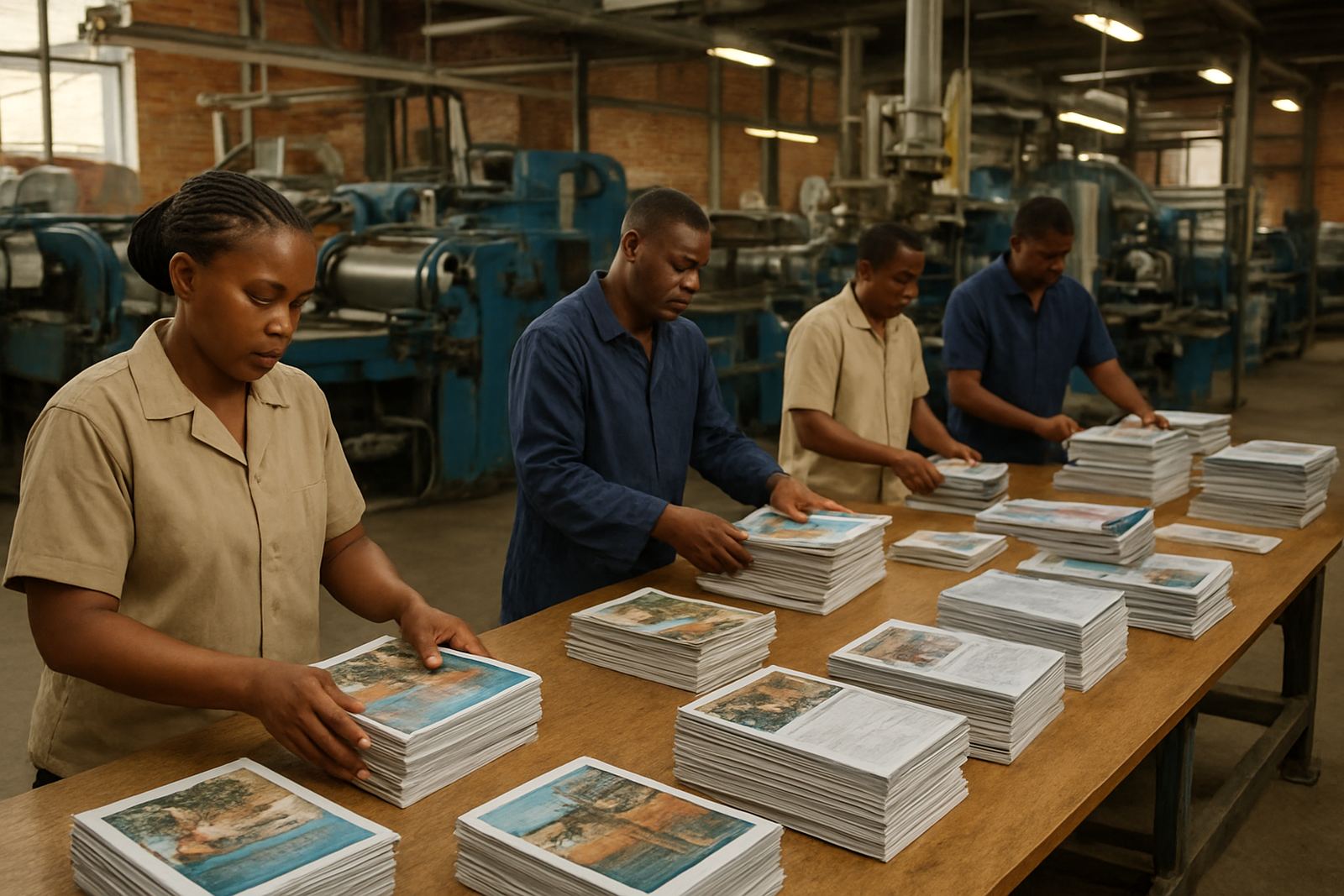


Printing for academic departments, faculties and research offices
Universities often need print work that is accurate, consistent, and delivered on time even when the calendar is crowded with exams, Senate dates, conferences and grant deadlines. Printing House works with faculties, research offices, libraries, student affairs teams and conference organisers who need journals, proceedings, abstracts, annual reports and programme books that look professional and hold together well in regular use.
Many institutional jobs start with a simple brief but end up carrying a lot of detail. There may be multiple authors, corrected tables, faculty logos, co-publishers, ISBN or ISSN details, and strict approval steps. Our team in Industria handles the practical side of that process so the final product matches the approved layout and the print run arrives as planned. For universities in Johannesburg, Pretoria, Midrand, Sandton or farther afield, delivery can be arranged nationwide.
- Journal runs for research units and academic departments
- Conference programmes, abstracts and proceedings
- Annual reports, institutional reviews and donor publications
- Student booklets, handbooks and policy packs
Choosing the right print method for the job
Academic printing is rarely one-size-fits-all. Offset printing is usually the better choice for longer runs, tighter colour control and cost efficiency when a publication will be printed again in future. Flexo printing can suit selected packaging or insert requirements, but for journals, conference material and bound publications the main focus is often on offset, proofing and reliable finishing.
We help clients match the method to the volume and the end use. A small internal symposium booklet might only need a few hundred copies, while a faculty journal or annual conference proceedings can stretch into thousands. Short runs with complex cover work need different planning from bulk institutional print, and that affects the budget, lead time and finishing sequence. In Johannesburg printing terms, that planning saves time and keeps overruns down.
- Offset printing for journals, reports and longer runs
- Prepress checks to catch layout errors before plate work
- Colour proofing for covers, charts and photos
- Packing and dispatch for multi-campus delivery
Layout planning for journals and conference books
The strongest university publications are planned before a single page is locked off. Page size, binding choice, image resolution, paper weight and spine thickness all affect how the publication reads and how it survives handling. Research reports with many tables need spacing that remains clear in print, while conference books should be easy to carry, quick to flip through and durable enough for repeated use over several days.
Our prepress team checks margins, bleeds, page order, image quality and colour settings so the file set is ready for production. If a faculty wants a more formal finish, case binding or section sewing may be suitable. For annual conference material or student guides, perfect binding or saddle stitching can make more sense depending on page count. In coastal humidity or heavy daily use, a laminated cover often adds practical value and helps the book keep shape.
- Allow enough inner margin for binding, especially on charts and tables
- Keep photos and logos in strong resolution, not copied from web files
- Build in time for proofreading by academics and administrators
- Plan cover spine width only after page count and paper stock are final
Binding and finishing that suit academic use
Universities need finishes that are neat but also useful. A journal sent to reviewers may need a simple saddle stitched format, while a research report for council or a departmental review may call for perfect binding with a laminated cover. Where a publication is meant to stay in circulation for years, case binding or section sewing gives more structure and better wear. We also offer foil finishing and die cutting when a special presentation is required for launches, donors or special events.
Finishing can be the difference between a document that feels temporary and one that reflects the standard of the institution. Practical choices also matter. A matte laminate may suit a serious research title, while gloss can work well for photo-led university magazines and open day books. The choice should be made with handling, storage and transport in mind, not just appearance.
- Saddle stitching for low page counts and handouts
- Perfect binding for journals, reports and programme books
- Case binding and section sewing for library or archive use
- Cover lamination and foil finishing for presentation copies
Common mistakes we see on tertiary print jobs
University jobs often run late because many people must approve them, and that can create avoidable print problems. One common mistake is leaving proofreading until the last day, which leads to rushed corrections and layout shifts. Another is underestimating the number of copies needed for departments, libraries, donors, reviewers and archive records. It is also common to approve artwork before final page counts are known, which changes the spine and can affect the whole cover.
We also see jobs where charts are supplied in low resolution, or where too many fonts and styles have been used across chapters. Those issues can make a publication look uneven once it is printed. Our production team, including Johan van der Merwe in prepress and Busisiwe Motaung in production, checks files carefully before presswork begins. That attention helps avoid waste and reprints, which matters when budgets are tight.
- Final text still changing after layout approval
- Incorrect page numbering in proceedings and research collections
- Paper stock chosen without considering binding thickness
- Too little time allowed for proof review and sign off
Budget ranges for university printing in Rand
Budgets vary widely because a conference booklet, a faculty journal and a bound research volume do not share the same production steps. As a guide, smaller saddle stitched booklets for internal use may start from about R3 500 to R9 000 depending on page count and quantity. Perfect bound journals and reports often sit in the range of R12 000 to R45 000 for medium runs, while heavier academic publications with lamination, section sewing or case binding can move from R25 000 upwards depending on specification.
For large institutional runs, the unit cost usually improves as quantity increases, but only if the files are ready and the page count is settled. We work with clients across Sandton, Randburg, Roodepoort, Midrand, Pretoria and the East Rand, and many prefer split deliveries to different campuses or faculties. Siyanda Ramaboa in client services and Leanne Naidoo in logistics help manage that practical side so the finished work reaches the right place on time.
- Basic booklet runs: about R3 500 to R9 000
- Perfect bound publications: about R12 000 to R45 000
- Bound presentation and archive copies: from about R25 000
- Delivery costs depend on volume, route and campus split
How we handle delivery, packing and repeat orders
Universities often need split deliveries to offices, libraries, conference venues and satellite campuses. We pack and dispatch with multi-point university delivery in mind. Copies can be boxed by department, labelled for different destinations, and sent nationwide from Industria in Johannesburg. This is useful when a single print run must reach a main campus, a regional campus and external reviewers at the same time.
Repeat orders are simpler when the first job is planned well. Once artwork, paper choices and binding are confirmed, follow-up runs become easier to quote and faster to schedule. That helps when an annual journal, student guide or conference book must be updated each year without starting from scratch. Oupa Hlungwani leads the business with a focus on careful print control and clear communication, which suits institutions that need dependable delivery and proper documentation.
For universities looking for practical print support, the aim is straightforward: accurate pages, tidy finishing and delivery that fits the academic calendar.